.png)
Tatmadaw Advances in Kachin and Chin States

Updated: Jul 20

For decades, Myanmar has struggled to establish lasting political stability. Since gaining independence in 1948, the country has experienced repeated military interventions, ethnic insurgencies, and intermittent civil wars that have prevented the emergence of a durable and inclusive political order. The military coup of 1 February 2021 plunged Myanmar into its most widespread internal conflict in decades, transforming nationwide protests into a multi-front armed rebellion involving the Tatmadaw, long-established ethnic armed organizations, newly formed People's Defense Forces (PDFs), and numerous local resistance groups. More than five years later, the conflict shows little sign of ending, raising an increasingly important question: is Myanmar's civil war entering a new phase?
The first years following the coup were characterized by rapid resistance advances and significant territorial losses for the military. Many observers viewed the Tatmadaw as an institution in decline, struggling to maintain control beyond major urban centers while relying increasingly on air power to compensate for its weakening ground forces. However, developments during 2025 and the first half of 2026 suggest that the balance of power may once again be shifting. The Tatmadaw has begun adapting its military strategy, reopening critical supply routes, strengthening diplomatic relationships, consolidating political authority, and launching coordinated counteroffensives aimed at reclaiming strategically important territory. At the same time, resistance forces continue to control vast areas, maintain resilient alliances, and challenge the military's authority across much of the country.
Nowhere are these competing dynamics more evident than in Kachin and Chin States. Both regions have become decisive battlegrounds, not only because of their strategic geography and border access but also because they illustrate two distinct dimensions of the wider conflict. Kachin represents a theater where one of Myanmar's most experienced ethnic armed organizations confronts renewed military offensives along critical logistical corridors. Chin, by contrast, demonstrates both the remarkable success of grassroots resistance movements and the political and military challenges of sustaining that success amid renewed junta offensives and internal fragmentation.

Background Briefs
Kachin State
Since the military coup of 1 February 2021, Kachin State has emerged as one of the most strategically important theaters of Myanmar’s civil war. Located along the border with China and rich in jade, gold, timber, and other natural resources, the state became a crucial base for resistance against the Tatmadaw. The principal actor in Kachin State is the Kachin Independence Army (KIA), which had already been fighting the Tatmadaw intermittently since the collapse of a ceasefire in 2011. Following the coup, the KIA quickly aligned itself with the anti-junta movement, providing military training, weapons, and sanctuary to newly formed People's Defense Forces (PDFs) and other resistance groups.

During 2021 and 2022, fighting intensified across Kachin State, particularly in and around Hpakant, Momauk, Waingmaw, Putao, Tanai, and areas surrounding the state capital Myitkyina. The KIA launched attacks on military bases, police stations, and transport routes while the junta responded with artillery bombardments and airstrikes. The state became a key logistical hub for the broader resistance movement because of its proximity to China and its established insurgent infrastructure. Throughout this period, the KIA sought not only to weaken the junta but also to regain territory and military positions lost during earlier conflicts.
KIA's operations entered a new phase after the launch of Operation 1027 in October 2023. Although the operation was initiated by the Three Brotherhood Alliance in Shan State, the momentum generated by the offensive encouraged the KIA to expand its own campaigns against the junta. Throughout 2024, the KIA captured numerous military outposts and increased pressure on junta forces across Kachin State and adjacent areas of northern Shan State and Sagaing Region. The Tatmadaw increasingly relied on air power because many ground positions became isolated and difficult to reinforce.

By 2025, Kachin State had become one of the junta’s most vulnerable fronts. The KIA and allied forces reportedly controlled large rural areas and important transportation corridors. According to a commentary by Michael Martin in the Center for Strategic and International Studies (CSIS) published in 2025, the KIA and associated resistance forces had captured more than 300 military installations and around fifteen towns across Kachin State, northern Shan State, and Sagaing Region since the coup. Control over border areas also enhanced the KIA’s political and economic influence. However, despite these gains, the junta continued to partially hold key urban centers such as Myitkyina and retained the capability to conduct airstrikes against resistance-held territory. The result by the end of 2025 was a military stalemate in which the resistance controlled much of the countryside while the junta maintained authority over several major administrative centers through air power and fortified positions.
Beyond the military dimension, Kachin State experienced severe humanitarian consequences. Tens of thousands of civilians were displaced, infrastructure was damaged, and access to healthcare and education deteriorated. The jade-mining areas around Hpakant remained contested. By December 2025, Kachin State stood as one of the strongest resistance strongholds in Myanmar and a central pillar of the broader rebel war effort.
Chin State
Chin State underwent one of the most dramatic transformations of any region in Myanmar following the 2021 coup. Historically one of the country's poorest and most remote states, Chin became a symbol of grassroots resistance after widespread public opposition to military rule evolved into armed struggle. The state borders both India and Bangladesh, giving it significant strategic importance and providing resistance groups with access to cross-border support networks and refugee routes.

In the months immediately following the coup, demonstrations erupted across Chin State, particularly in Hakha, Falam, Thantlang, Mindat, Kanpetlet, and Tedim. As the military cracked down on protests nationwide, local communities began forming self-defense groups that later evolved into Chin Defense Forces (CDFs). These groups worked alongside the longstanding Chin National Front (CNF) and its armed wing, the Chin National Army (CNA). By late 2021, Chin resistance groups had become active participants in the broader anti-junta coalition and were cooperating with the National Unity Government and other ethnic armed organizations.
One of the defining events of 2021 was the destruction of large parts of Thantlang. Repeated artillery shelling and fires devastated the town, forcing thousands of residents to flee to neighbouring India. Between 2022 and 2023, Chin resistance forces gradually expanded their territorial control. The mountainous terrain of Chin State favored guerrilla warfare and complicated military operations. Numerous local defense groups emerged, creating a highly fragmented but resilient resistance landscape. During this period, the Tatmadaw increasingly relied on artillery and air power rather than sustained ground control, mirroring the situation that would befall Tatmadaw units besieged in Arakan. Large portions of the countryside effectively slipped beyond the military’s reach.
The year 2024 marked both military progress and political fragmentation within the Chin resistance. While anti-junta forces continued to gain territory, disputes emerged over governance, representation, and the future political structure of Chinland. Rival political and military blocs developed, most notably between the Chinland Council aligned with the CNF and the newer Chin Brotherhood Alliance. These divisions reflected longstanding tribal, regional, and political differences among Chin communities. Despite these tensions, most factions remained united in their opposition to military rule.
The formation of the Chin Brotherhood Alliance in December 2023 significantly altered the balance of power within the state. The alliance brought together several major Chin resistance groups and sought greater coordination in military and political affairs. Throughout 2024 and 2025, Chin Brotherhood forces launched offensives against junta positions, including operations around Kyindwe and Falam.
A major turning point occurred in 2025 with the capture of Falam following months of intense fighting. Resistance groups viewed the victory as a strategic breakthrough because Falam is one of the state's most important towns and a key route connecting Chin State with India. The battle increasingly employed drones, coordinated assaults, and joint command structures. Despite the victory, the junta continued to conduct extensive airstrikes that caused widespread civilian suffering and displacement.
By late 2025, the junta's presence in Chin State had been reduced significantly. Resistance groups controlled much of the countryside and many towns, while the military retained only a limited number of strategic positions, including elements of the state capital Hakha and several fortified bases. Discussions among Chin organizations increasingly focused on post-war governance, state-building, and the unification of various armed groups. Efforts to establish broader political coordination among Chin factions gained momentum during 2025, reflecting a growing recognition that military success would need to be matched by political unity.
Humanitarian conditions nevertheless remained severe. Hundreds of thousands of civilians experienced displacement; many sought refuge in India's Mizoram State, and communities faced shortages of food, medicine, education, and basic services. Continuous airstrikes and periodic clashes prevented normal economic recovery. Yet by December 2025, Chin State had become one of the clearest examples of successful resistance to the Tatmadaw, with rebel forces remaining in control until mid-2026's Tatmadaw gains.
Recent Developments in Kachin State
In early 2026 fighting intensified across Kachin State as the Kachin Independence Army (KIA) and its allied resistance forces confronted renewed military operations by the State Administration Council (SAC). By 10 February 2026, clashes were simultaneously occurring in Bhamo Township, Waingmaw Township, Hpakant Township, and Indawgyi Township. According to KIA spokesperson Colonel Naw Bu, the fighting in Bhamo and Waingmaw stemmed from KIA offensives, while the clashes in Hpakant and Indawgyi were defensive operations against advancing Tatmadaw forces and the pro-Naypyidaw Shanni Nationalities Army (SNA). Hpakant previously faced a Tatmadaw offensive launched on 30 January 2025 to penetrate KIA-controlled territory.
During the first week of February, the fighting intensified across multiple fronts. On 4 February 2026, the junta carried out airstrikes using fighter aircraft and Y-12 aircraft in key conflict zones in Hpakant Township and Indawgyi Township. The following day, 5 February 2026, KIA-led forces captured a junta drone jammer and reportedly inflicted casualties on junta personnel during clashes. Along the route linking Hpakant Township and Indawgyi Township, KIA forces successfully recaptured Longton Village and Hepu Village, which had previously fallen to junta-aligned forces. In Waingmaw Township, clashes escalated following a junta and Lisu militia offensive north of Lamyan Village. On 3 and 4 February 2026, KIA forces seized four junta and militia checkpoints located between Mongnar Village and surrounding settlements. In response, the junta launched an airstrike against Shwenyaung Village on 4 February, causing significant destruction. Meanwhile, fighting in Bhamo Township continued unabated. The battle for Bhamo, Kachin State’s second-largest city, had already persisted for more than a year, with control of territory repeatedly shifting between the KIA and the military across several locations within the township.

By mid February 2026, fighting in Waingmaw Township had intensified further. KIA forces tightened their encirclement of Infantry Battalion 58 (IB-58), in some locations advancing to within approximately 100 meters of the battalion's headquarters. Near-daily exchanges of fire were reported around the base, while clashes also continued around Lamyin Village, located approximately eight kilometers from Waingmaw town. Simultaneously, heavy fighting remained ongoing in Bhamo Township, Hpakant Township, and Indawgyi Township, where civilian casualties continued to mount due to artillery strikes, airstrikes, and landmines.
Following the escalations, the KIA issued a public warning urging residents in Waingmaw Township, Bhamo Township, Hpakant Township, Indawgyi Township, Putao Township, and Nogmung Township to remain alert due to ongoing military operations. Daily clashes were reported in Bhamo Township around Tarmonglong Village, a logistics battalion compound, and the Infantry Battalion 47 (IB-47) base. The junta also continued conducting airstrikes and drone attacks in the area. In Waingmaw Township, junta forces launched operations from Warshawng Village in an effort to reinforce and secure IB-58. Fighting in Hpakant Township persisted, particularly around Hsengtaung Village, Lone Khin Village, and Mashikatong Village. During the first two weeks of February alone, the KIA reported 26 armed clashes across the Bhamo, Hpakant, and Waingmaw fronts.
The security situation deteriorated further in Hpakant Township in April. On 2 April 2026, clashes resurfaced after junta troops advanced into KIA-controlled areas in the jade-mining region. The fighting intensified around Lone Khin Village, particularly near the Rakhine migrant workers' center, where fierce battles were reported. Subsequently, on 21 April 2026, junta soldiers raided the Mai Hospital in Lone Khin Village and detained 21 individuals, including medical personnel, hospital staff, patients, and relatives. Reports also emerged that junta troops and allied militia members engaged in widespread looting following their seizure of Lone Khin. Although large-scale ground combat subsided briefly after the raid, sporadic artillery and drone exchanges continued throughout the township.
On 19 May, junta reinforcements were deployed to Mongnar Village in Waingmaw Township. Simultaneously, troops and weapons were concentrated in Tanghpe Village in Myitkyina Township in preparation for possible operations targeting Sadon, Kan Paik Ti, Chipwi, and Tsawlaw, all strategically important towns near the Chinese border.
The KIA announced that it was shifting from offensive operations to a defensive posture in response to substantial military reinforcements arriving in Kachin State. Large quantities of troops, weapons, ammunition, and 300 vehicles, including mobile howitzers, left Mandalay on May 9 to be delivered to the Northern Command Headquarters in Myitkyina. The first convoy arrived in Myitkyina on 12 May after the junta recaptured the Mandalay–Myitkyina Road through the Sagaing Region and secured the strategic towns of Indaw and Maw Luu in upper Sagaing, restoring access along the vital highway linking Mandalay and Myitkyina. The regime subsequently imposed martial law in Sumprabum Township, Shwegu Township, Injangyang Township, Tsawlaw Township, and Chipwi Township. At the same time, fighting intensified in Hpakant Township, while junta troops advanced southward from Shwegu Township toward Mabein in northern Shan State.

On 22 May 2026 a second major military convoy departed Mandalay and arrived in Myitkyina on 31 May 2026 after traveling along the reopened Mandalay–Myitkyina Highway. The convoy, consisting of approximately 300 vehicles and, according to some reports, 200 vehicles, encountered resistance attacks along its route. Clashes were reported in areas surrounding Katha, Indaw, Maw Luu, and especially in Namseeawng Village, where the KIA attempted an ambush targeting the convoy in Monghnyin Township. Despite the reopening of the highway, security conditions remained unstable along the corridor linking central Myanmar to Kachin State.

The focus of fighting shifted increasingly toward Shwegu Township in June. KIA Brigade 11 issued an urgent evacuation order for civilians in Shwegu and announced the closure of major roads leading into the town. The warning followed intensified clashes between KIA-led forces and junta troops advancing from Ngar Oocountries, 53 km from where a light infantry battalion was based. The KIA stated that fighting was occurring at multiple junctions surrounding the township. Earlier, on 4 June 2026, junta aircraft had bombed a cottage hospital in Sitha Village, killing three civilians and damaging the building. A KIA frontline source said regime troops advancing from Ngar Ooe successfully linked up with forces in Shwegu and established a position in nearby Mannarlay village, though they had not yet advanced towards Bhamo and the fighting had halted.
According to data released by the United Nations High Commissioner for Refugees (UNHCR), the number of internally displaced persons in Kachin State had reached 244,550. Daily clashes continued in Waingmaw Township, Bhamo Township, and Hpakant Township, while fears of additional displacement increased following evacuation notices issued in Shwegu.
By mid-June 2026, intense fighting continued in Shwegu Township as junta forces sought to advance towards Bhamo Township, with clashes occurring near the Shwegu–Bhamo Junction and along the Ngar Ooe–Shwegu Road. On 15 June 2026, junta aircraft reportedly carried out around twenty bombing runs in support of ground operations. Since early May, the regime had reinforced Shwegu with approximately 500 troops from Light Infantry Battalion 121 based in Ngar Ooe Village, advancing north in three columns and reportedly sustaining around 100 casualties during clashes with resistance forces. This continued while KIA and allied resistance forces launched counteroffensives along the Ngar Ooe–Shwegu Road, recapturing several junta positions. Although Shwegu remained under regime control, the KIA warned civilians to evacuate in anticipation of further clashes, while Bhamo continued to face junta artillery shelling, drone strikes, and aerial bombardment despite a temporary reduction in ground combat.

Five civilians from Shwe Phone Myint Village in Shwegu Township, Kachin State, were reportedly killed by junta troops after a column left Shwegu Town on 13 June, entered the village, abducted residents, and carried out killings, with local sources alleging victims were accused of supporting resistance forces. Fighting continued across four fronts in Shwegu Township, with daily clashes and shifting control up to 16 June, including a brief lull on the night of 14 June. The junta deployed artillery from Shwegu Town and Ngarbatkonegyi Village and advanced forces from Infantry Battalion 56 with reinforcements arriving from Tagaung and Htigyaing via the Shwegu–Ngar Ooe Road starting 6 June amid broader troop build-ups since 5 May. In response, the Arakan Army (AA) launched operations from the Hnawpingyi junction towards Ngar Ooe, while on 8 June the KIA ordered civilian evacuation and announced the closure of the Shwegu–Ngar Ooe Road.
Recent Developments in Chin State
On 12 January 2026, major resistance organizations and their associated administrative bodies formally merged to create the Chin People's Union (CPU) and the Chin People's Army (CPA). The new unified structure brought together forces from Mindat Township, Matupi Township, Kanpetlet Township, and the Daai region of southern Chin State. The consolidation included the Mindat Township Revolutionary Leading Committee, Mindat Township People's Administration, CDF-Mindat, the Matupi Revolutionary Federation/CDF-Matupi, the Kanpetlet Township Council, Kanpetlet Township People's Administration, CDF-Kanpetlet, the Daai Regional Council, and CDF-Daai. The move represented a major political and military restructuring in southern Chin State, transforming a loose coalition into a more centralized resistance command and strengthening the administrative framework across liberated areas in Mindat, Matupi, Kanpetlet, and Daai.

On 20 February 2026, the resistance group CDF-Hakha carried out a suicide drone attack in Hakha, the capital of Chin State, targeting a Chin National Day ceremony attended by junta officials, including Border and Ethnic Affairs Minister Yar Pyae. Although the minister survived the attack and subsequently departed for Kale in Sagaing Region, the incident highlighted the vulnerability of junta authorities even in areas under nominal government control. Following the attack, security forces reportedly conducted raids in Hakha and targeted an electricity supply office suspected of being connected to the drone operation.

Early March 2026, intense fighting occurred in Falam Township as Chin resistance forces attempted to halt a major junta advance from Kale Town in Sagaing Region toward Falam Town. On 13 March, a junta airstrike on Falam Town killed CNA Captain Nyan Lin Aung, Lance Corporal Man Date Nwam, and resistance fighter Shan Byet. On 15 March, heavy clashes resulted in the deaths of Byet Hlay Kyone of CDF-Zophei, Salai Khin Bway of CDF-Zotung, CDF-Hualngoram member Vanneihhlua, and Chin National Army fighter Maung Gyi. During the same period, CDF-Thantlang commando leader Salai Van Nun Ham was killed in an accidental explosion in Thantlang Town. At the time, junta forces were firmly established in the villages of Sumhrang, Khuangli, and Lumbang in Falam Township and were actively advancing toward both Falam Town and Surbung Airport. The military was simultaneously pushing toward Falam via the Waibula–Falam Road and the Taingen–Falam Road.
On 6 April 2026, the fifth anniversary of CDF-Thantlang was commemorated at an undisclosed location in Thantlang Township. During the event, the organization pledged to continue military operations aimed at removing remaining junta positions throughout Thantlang Township and eventually across all of Chin State. A major turning point occurred on 25 April 2026, when the Myanmar military recaptured Falam Town and Surbung Airport after a six-month offensive that had begun in October 2025. The operation involved intensive airstrikes, artillery bombardment, and ground assaults. Resistance forces, including the Chin Brotherhood and allied groups, were ultimately forced to withdraw after failing to withstand sustained aerial attacks and ammunition shortages. The loss of Falam marked one of the most significant setbacks for Chin resistance forces since capturing the town in April 2025.

The fall of Falam accompanied clashes along the Falam–Hakha corridor. Fighting occurred in the villages of Lone Pi, Laizou, and Rilthi, while additional engagements took place along the Kale–Falam Road. On 26 April, CDF-Zotung platoon commander Salai Thein Kyaw was killed during fighting between Taingen and Zotung villages. The military sought to consolidate control of the entire Falam-Hakha axis while resistance forces conducted delaying operations and attacks against advancing columns.
Simultaneously, on 25 April 2026, junta troops seized Kyaung Gyi Village in Saw Township, Magway Region. Although outside Chin State, Kyaung Gyi is strategically important because it lies on a crucial junction linking Magway Region, Chin State, and Rakhine State. Located approximately 12 miles from Mindat, the occupation disrupted trade routes and threatened resistance-controlled areas in southern Chin State, particularly Mindat and Kanpetlet.

On 29 April 2026, a Tatmadaw Lay Yak-130 light combat aircraft bombed an area near Mone Chaung Bridge in Kyindwe, Kanpetlet Township, killing nine civilians who were repairing the bridge. On 1 May 2026, another airstrike struck Khawpuichhip Village in Falam Township along the strategic Falam–Rihkhawdar Road near the Indian border. Six civilians, including children, were killed and many others injured. The attack triggered a wave of displacement toward Zokhawthar in India's Champhai District, with refugees crossing from areas around Rihkhawdar, a key border trade hub connecting Chin State and India's Mizoram State.
On 5 May 2026, junta forces recaptured the strategically significant Kennedy Peak in Tedim Township following several days of intense combat. The operation involved continuous airstrikes, drone attacks, and a coordinated ground advance from Thaing Ngin Village. Kennedy Peak, which contains important communications infrastructure and broadcasting facilities, had changed hands multiple times since late 2023.
The military's momentum continued on 19 May 2026, when junta troops and the pro-Naypyidaw Zomi Revolutionary Army-Eastern Command (ZRA-EC) recaptured Tonzang Town following a three-day battle. The offensive involved a pincer movement from Tedim in the south and Cikha in the north, supported heavily by air power. Approximately 600 to 800 troops had been advancing toward Tonzang since 11 May, occupying villages along the route. Many displaced people had returned after the resistance took over in May 2024 but had to flee again due to recent advances by the Junta.

Women's for Justice reported that the junta had intensified air operations across Chin State, including the alleged use of internationally banned cluster munitions. On 23 May 2026, the Senthang Central Council (SCC) issued warnings regarding a possible large-scale military offensive in the Senthang region, cautioning that junta forces could enter from multiple directions. On 25 May, the Yaw Defense Force (YDF) similarly urged residents of southern Chin State and Yaw Township in neighboring Magway Region to evacuate due to escalating fighting, heavy artillery fire, and extensive airstrikes.
By late May 2026, the junta had begun transporting reconstruction materials from Naypyidaw and Mandalay through Kale Town toward Falam, Tedim, and Tonzang. Materials arrived in Falam on 26 May, while plans were announced to rebuild hospitals, schools, administrative buildings, markets, and religious structures damaged during the conflict. The military simultaneously claimed full control of northern Chin State while continuing operations in southern areas.

In May 2026, a major junta offensive was underway against southern Chin State. Forces advancing from Saw Township and Kyaukhtu Township targeted Kanpetlet and Mindat, supported by heavy airstrikes launched from the Kyaukhtu Air Base. Kyaung Gyi Village, sitting on a vital junction of the Kyaukhtu-Mindat road, became a major logistical base for these operations. At the same time, military aircraft intensified bombing of Mindat, Matupi, and Kanpetlet, while approximately 10,000 civilians fled their homes. The Junta forces faced heavy losses on the Kanpetlet front and simultaneously bolstered the Kyaung Gyi base by constructing bunkers and trenches. By the end of May 2026, the first military column had advanced to within eight kilometers of Mindat Town. Among the two major columns, the first one moved from Kyaukhtu-Mindat Road, and the other advanced via Pansan Village and Hinchaung Village. Resistance forces under the CPA and allied groups continued to resist the offensive, while displacement in Mindat Township exceeded 17,000 people.
Outlook
The developments observed during the first half of 2026 indicate a noticeable shift in the strategic position of Myanmar's military junta. After suffering significant territorial losses following the 2021 coup and the resistances' momentum generated by Operation 1027, the Tatmadaw appears to have entered a phase of military and political recovery. This recovery can broadly be understood through two interconnected dimensions: the strengthening of its political position and the improvement of its military strategy.
Politically, the junta has benefited from a more favorable diplomatic environment than in previous years. Following the setbacks inflicted by Operation 1027, China assumed a more active diplomatic role aimed at stabilizing its border, protecting bilateral trade, and safeguarding its strategic investments in Myanmar. China facilitated negotiations between the Tatmadaw and several ethnic armed organizations, encouraging ceasefire arrangements that eased military pressure on the junta. A ceasefire agreement between the Ta'ang National Liberation Army and the Myanmar military came into effect on 28 October 2025, significantly reducing hostilities in parts of northern Shan State.
Previously, on 20 January 2025, China's Foreign Ministry publicly announced that the Myanmar National Democratic Alliance Army and the Myanmar military had reached a formal ceasefire agreement during negotiations in Kunming. Beyond mediation, Beijing also exerted economic pressure on armed groups. In May 2025, Chinese authorities reportedly warned the Kachin Independence Army that imports of rare earth minerals from KIA-controlled territory could be suspended unless the group halted its advance on Bhamo. Collectively, these diplomatic and economic measures reduced pressure on multiple fronts, enabling the Tatmadaw to preserve key positions, reopen strategic supply routes, redeploy forces from northern Shan State, and concentrate greater military resources on renewed offensives in Kachin and Chin States. In contrast, the Arakan Army declined to enter a ceasefire and has continued military operations against the junta, ensuring that western Myanmar remains an active theater of conflict.
More recently, Min Aung Hlaing's assumption of the presidency following the 2026 election, despite the election being widely criticized by international observers and many governments as a sham, has altered the junta's political posture. Unlike the immediate post-coup period, the regime now presents itself as an elected civilian government rather than solely a military administration. This has enabled Min Aung Hlaing and the newly elected government to conduct diplomatic visits and strengthen engagement with countries including Russia, China, Belarus, and India. Domestically, a number of resistance organizations and local leaders have reportedly congratulated his inauguration, suggesting that some actors are increasingly willing to engage politically with the new administration, although the extent and significance of such support remain contested.
The junta's recent military strategy shows a synchronization between military gains along the India–Myanmar frontier and improving bilateral relations with New Delhi. This became evident during the first half of 2026. Between 2 and 5 May 2026, Indian Chief of the Naval Staff Admiral Dinesh Kumar Tripathi conducted an official goodwill visit to Myanmar, holding meetings with Commander-in-Chief of the Myanmar Armed Forces General Ye Win Oo, Defense Minister General U Htun Aung, and Commander-in-Chief of the Myanmar Navy Admiral Htein Win. The visit coincided with the deployment of INS Satpura (F-48) and INS Sunayna (P-57) to Yangon as part of India's continuing naval engagement under its Act East and MAHASAGAR initiatives, reaffirming military-to-military cooperation and maritime security cooperation between the two countries.

Within days of these engagements, the Tatmadaw intensified operations across northern Chin State, with the recapture of Kennedy Peak on 5 May, the fall of Tonzang on 19 May, and military columns continuing to advance along the Kale–Falam Road, the Tedim–Tonzang axis, and the Falam–Rihkhawdar corridor towards towns bordering India's Mizoram State. Shortly afterwards, President Min Aung Hlaing undertook his first official state visit to India from 30 May to 3 June 2026, meeting External Affairs Minister Dr. S. Jaishankar and Prime Minister Narendra Modi in New Delhi. Bilateral discussions focused on border security, connectivity, implementation of the Kaladan Multi-Modal Transit Transport Project and the India–Myanmar–Thailand Trilateral Highway, as well as wider economic and strategic cooperation. Although no public evidence demonstrates that the military offensives were coordinated with these diplomatic engagements, the chronology suggests that the junta sought to demonstrate an improving security environment along the India–Myanmar border while simultaneously expanding defense and political ties with New Delhi.
The composition of forces participating in these offensives further illustrates the regional character of the conflict. During the operation to recapture Tonzang, junta forces were supported by the Zomi Revolutionary Army–Eastern Command (ZRA-EC), an offshoot of the original Zomi Revolutionary Army (ZRA), an organization with a strong presence in India's northeastern states. Their presence has been strong particularly in Mizoram and Manipur, where it has long maintained cross-border ethnic and logistical networks. Unlike the original ZRA, the Eastern Command has aligned itself with the Tatmadaw and has actively participated in operations against anti-junta resistance forces. The offensive towards Tonzang and other settlements bordering India therefore relied not only on conventional Tatmadaw formations but also on an armed organization whose origins and support networks extend across the India–Myanmar frontier. As Naypyidaw strengthens defense cooperation with New Delhi while simultaneously advancing into strategically important border townships such as Falam, Tedim, and Tonzang, developments in Chin State are becoming increasingly intertwined with India's security interests, cross-border infrastructure projects, and broader Act East strategy.
The junta has also attempted to improve its domestic legitimacy by complementing military operations with reconstruction and administrative initiatives. Following the recapture of several towns, authorities transported timber, construction materials, and humanitarian supplies to rebuild hospitals, schools, markets, religious buildings, and other public infrastructure damaged during years of conflict. Government officials, including President Min Aung Hlaing, have framed these efforts as restoring communities allegedly destroyed by "terrorist" resistance groups. Whether these measures translate into sustained public support remains uncertain, but they demonstrate an increasing recognition that military victories alone are insufficient without restoring governance and civilian confidence.
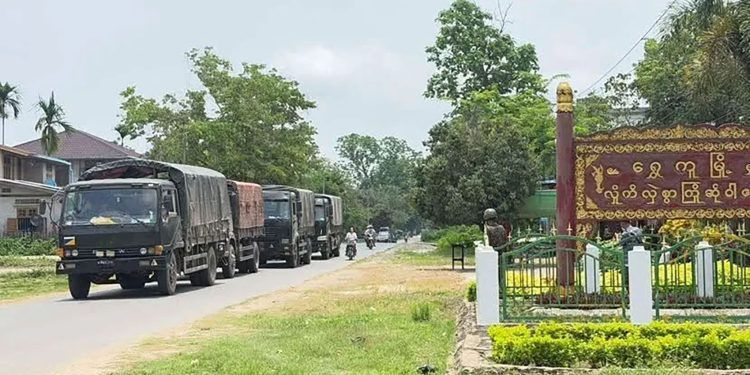
From a military perspective, the Tatmadaw appears to have adapted its operational priorities. During much of the conflict after 2021, the military relied heavily on air power while struggling to conduct effective ground operations in terrain dominated by guerrilla warfare. The recent offensives indicate a deliberate effort to address this weakness by prioritizing the capture and security of major transport corridors. Rather than focusing exclusively on isolated strongholds, the junta has concentrated on reconnecting logistical networks to facilitate troop movement, sustain supply lines, and enable larger-scale ground offensives. In Kachin State, the reopening of the Mandalay–Myitkyina Highway through Indaw and Maw Luu, reinforcement of Myitkyina via repeated military convoys, and operations advancing through Shwegu toward Bhamo illustrate this strategy. Similarly, in Chin State, advances along the Kale–Falam Road, the Falam–Hakha corridor, the Falam–Rihkhawdar Road, the Kyaukhtu–Mindat Road, and the Tedim–Tonzang axis demonstrate the military's emphasis on securing transportation routes before expanding territorial control.
These campaigns have produced varying outcomes across Myanmar's border regions. In Kachin State, where road infrastructure is comparatively more developed, the military has successfully restored logistical connections, reinforced forward positions, and regained territory in several strategically important areas. Although fighting continues around Bhamo, Waingmaw, Hpakant, and Shwegu, the Tatmadaw has demonstrated an improved capacity to reinforce frontline units while simultaneously maintaining offensive pressure. In contrast, Chin State presents considerably greater operational challenges. While the junta successfully recaptured Falam, Kennedy Peak, Tonzang, and several northern transport corridors, resistance remains strong across the southern part of the state. Ongoing battles around Mindat, Kanpetlet, and Matupi, combined with the mountainous terrain and limited transport infrastructure, continue to restrict the pace of military advances. Furthermore, the presence of the Arakan Army (AA) in neighbouring Rakhine State and its control of Paletwa create additional strategic constraints along southern Chin State. Unlike the Myanmar National Democratic Alliance Army (MNDAA) and the Ta'ang National Liberation Army (TNLA), both of which entered ceasefire arrangements following Chinese mediation, the Arakan Army remains actively engaged in military operations against the junta, limiting the Tatmadaw's ability to fully consolidate control over western Myanmar.
Another notable development is the apparent improvement in the military's operational sustainability. Earlier phases of the conflict were characterized by frequent reports of defections and declining morale within junta ranks. During the recent offensives in Kachin and Chin States, however, large-scale reports of desertion have been limited. Although no independent research has conclusively demonstrated that desertion has declined, the military's ability to deploy repeated reinforcements, sustain lengthy offensives, and maintain multiple simultaneous campaigns may indicate improvements in organizational cohesion and force management. This observation remains speculative and requires further empirical investigation.
Overall, the evidence suggests that Myanmar's conflict has entered a new stage. The Tatmadaw no longer appears solely focused on preventing regime collapse but is increasingly attempting to restore governance, secure critical infrastructure, strengthen diplomatic engagement, and re-establish long-term state authority. Backed by improved relations with China, an administration that claims electoral legitimacy, expanding diplomatic engagement, reconstruction initiatives, and more coordinated military operations, the recovery from many of the setbacks experienced during 2023 and 2024 is being slowly achieved
Whether these developments ultimately enable the military to reunify Myanmar remains uncertain, as resistance forces continue to retain substantial territorial control and the political legitimacy of the current government remains deeply contested. Nevertheless, the campaigns in Kachin and Chin States demonstrate that the conflict is no longer characterized solely by resistance advances; instead, it reflects an increasingly dynamic contest in which the Tatmadaw has regained strategic momentum and is actively attempting to reshape both the military and political landscape of Myanmar.
Verification Note: The information in this report has been compiled from multiple credible sources and cross-checked for consistency. Data and reports have been used to corroborate events where possible. While every effort has been made to ensure accuracy, access limitations may prevent independent verification of all details. Maps were generated via Google My Maps. While functionally accurate for this report, they are not intended for precision cartography.
Comments